

Event Photography That Strengthens Alumni Engagement and Institutional Branding
June 19, 2025
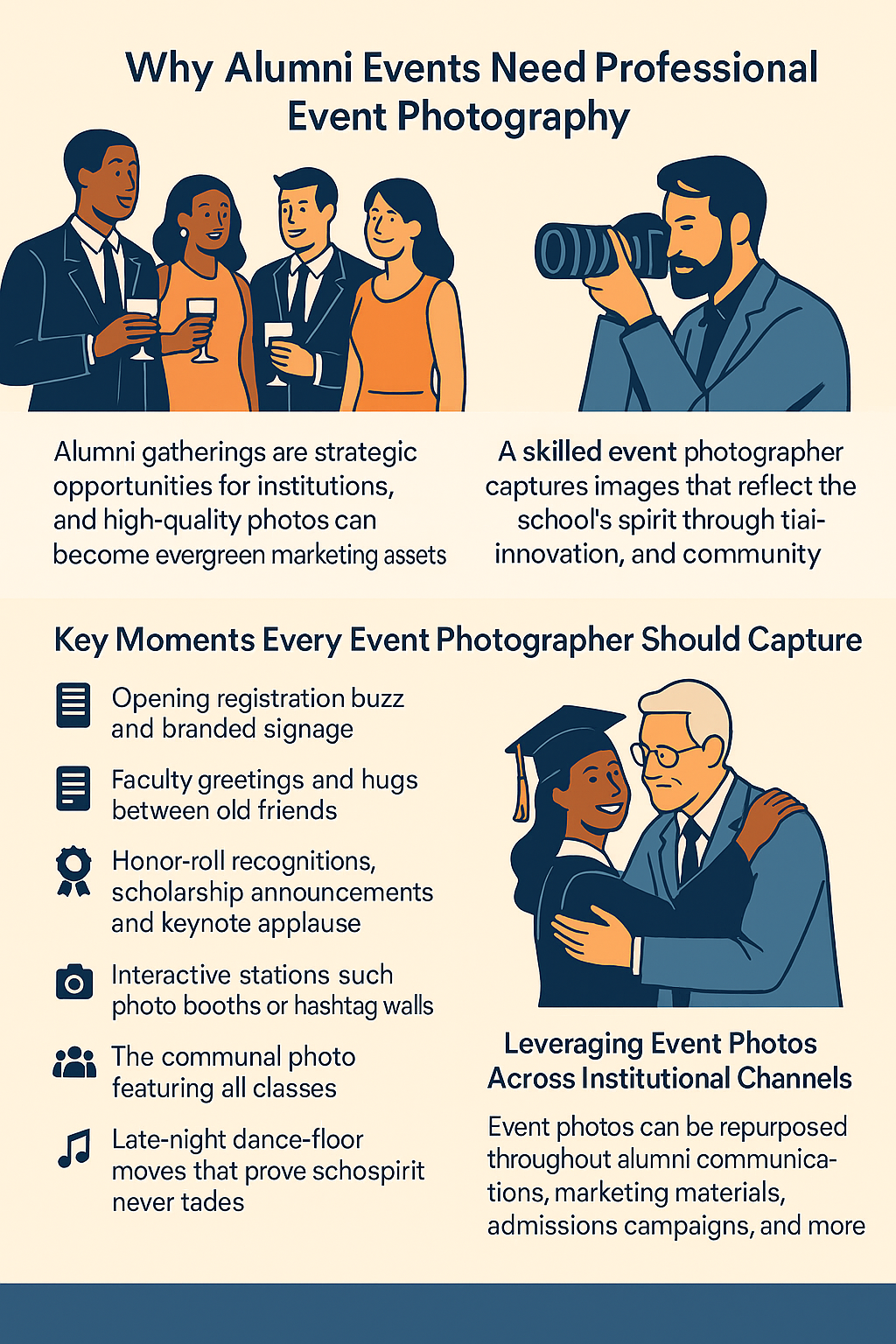
Why Alumni Events Need Professional Event Photography
Alumni gatherings are mo re than casual reunions; they are strategic opportunities for institutions to deepen relationships, encourage donations, and inspire school pride. High‑quality event photography turns those opportunities into evergreen marketing assets. Clear, vibrant images let graduates relive the excitement long after the event ends, and they show prospective students that your campus culture thrives. A skilled event photographer understands how to capture the school’s spirit so every photo speaks to tradition, innovation, and community.Professional coverage also reassures stakeholders that the institution values excellence in every detail. When donors see polished event photos in annual reports or on social feeds, they connect that visual quality to the overall integrity of your programs. In short, professional event photography doesn’t just document good times; it fuels retention and recruitment.
Crafting a Visual Story That Resonates with Graduates
Strong storytelling b egins before the event starts. We meet with your communications team to identify the key moments—from the first handshake at registration to the standing ovation during the awards toast. Creating a detailed shot list ensures we never miss an essential scene. Because most events follow a predictable flow, plotting those beats helps our photographer anticipate where emotion will peak.During the celebration we work unobtrusively, blending candid shots with posed portraits so alumni appear natural yet polished. The final gallery becomes a narrative your marketing department can repurpose across brochures, slide decks, and donor pitches. Each frame reinforces the institution’s personality and mission.
Key Moments Every Event Photographer Should Capture
- Opening registration buzz and branded signage
- Faculty greetings and hugs between old friends
- Honor‑roll recognitions, scholarship announcements, and keynote applause
- Interactive stations such as photo booths or hashtag walls
- The communal photo featuring all classes
- Late‑night dance‑floor moves that prove school spirit never fades
These highlights remind alumni why they loved campus life, prompting them to share posts, tag classmates, and expand organic reach.
From Registration to Farewell: The Full Journey
Great coverage begins the second guests walk into the venue. We start shooting wide room shots to showcase décor, banners, and lighting. As the crowd grows, our camera settings shift to fast apertures so we can isolate interesting subjects and foreground emotions. Throughout the evening we alternate between a telephoto lens for discreet candids and a wide prime for group interactions, ensuring variety in the final photos.By the time the house lights rise, we’ve documented the entire arc—arrival, keynote, networking, after‑party, and final farewells. This complete timeli ne gives communicators content for every channel, from Instagram Stories to printed lookbooks.
Leveraging Event Photos Across Institutional Channels
Once edited, yo ur event photos become versatile promotional assets. Use carousel posts on LinkedIn to attract corporate sponsors, or embed a slide show on your alumni portal for password‑protected nostalgia. Admissions teams can also feature images from the gala in campus‑visit packets, proving that the community remains vibrant long after graduation day. Remember, a single reunion can supply enough visuals for months of posts—maximizing ROI from one night of shooting.Building a Consistent Brand Through Corporate Event Photography
When your univer sity hosts a major donor dinner or industry symposium, the tone mirrors a high‑end corporate event. Our approach adapts with tailored lighting setups, formal posed group shots, and on‑brand backdrops. By maintaining consistent color grading across galleries—whether it’s a career fair or a golden‑class anniversary—we reinforce a cohesive visual identity that distinguishes your institution in the crowded higher‑ed marketplace.Technical Essentials for High‑Quality Images
Reunions often unfold in grand halls with challenging lighting. To keep noise low in low light situations, we pair fast lenses with full‑frame sensors, then add bounced flash or discreet on camera flash when ambient illumination falls short. Fresh memory cards, dual‑slot back‑ups, and fully charged batteries ensure that equipment glitches never derail coverage.Dress code matters, too. We dress appropriately—black attire and soft‑sole shoes—so we remain invisible while moving around the room. Preparedness and professionalism go hand in hand.
Posed Group Shots That Spark Community Spirit
Alumni crave keepsak es with classmates. We position groups against branded step‑and‑repeat banners, guiding them with quick cues to keep lines moving. Each person leaves with a share‑worthy photo that doubles as a recruitment tool when posted online. These smiling faces ar e living testimonials of campus loyalty.Interactive Elements: Photo Booths and Live Displays
Adding a modern photo booth generates immediate social buzz. Guests print strips as souvenirs, while digital copies upload straight to an event album—driving post‑function engagement. Pairing the booth with live displays lets attendees watch a real‑time slideshow of the evening’s funniest moments, amplifying excitement and user‑generated content.Post‑Production: Editing for Impact and Consistency
Our editors balan ce color, remove distractions, and crop for dynamic composition. We deliver a curated set of high‑resolution images optimized for web and print, complete with consistent watermarks that reinforce your brand. Because timely delivery is essential, we share selects within 4 8 hours so marketing can leverage fresh visuals while excitement is still high.
Working with a Dedicated Team to Maximize Coverage
Large‑scale dinners or homecoming weekends benef it from a dedicated team of shooters. One photographer focuses on stage action with a telephoto lens, another covers candid hallway interactions, while a third manages lighting for posed portraits. Coordinated walkie‑talkie check‑ins guarantee no key moments are missed.Measuring Success: Engagement Metrics and Feedback
The proof is in the n umbers. Track likes, shares, and click‑through rates on alumni newsletters featuring reunion content. Correlate spikes in donation page visits or scholarship sign‑ups with the release of your event photos. Qualitative feedback—“I felt like I was back on campus!”—is e qually telling.Choosing the Right Event Photographer for Your Institution
Look for a portfoli o rich in corporate event photography, not just wedding photography or birthday parties. Ask about redundancy plans, preferred lenses, and experience with different types of higher‑ed functions. Professionalism, punctuality, and the capability to prepare for unexpected weather or program changes are non‑negotiable.Bringing It All Together for Lifelong Connections
Powerful imagery can reignite school pride, deepen donor loyalty, and inspire future applicants. With strategic planning, expert shooting, and thoughtful editing, your next reunion becomes a branded story that lives long beyond the final toast.Making the Most of Natural Light and Unscripted Moments
Great event photography is ab out anticipating what will happen, not just reacting to it. Using natural light whenever possible adds warmth and authenticity to the atmosphere, whether we're capturing handshakes in an open-air atrium or a toast near a window-lit ballroom. Alumni events often unfold in dynamic ways, so we photograph not only what’s planned—but also the spontaneous smiles and unscripted laughs that tell a deeper story.Of course, you can expect us to scout the space beforehand to identify key lighting zones and vantage points. At every point in the event, we’re looking for meaningful frames that elevate the experience. For example, catching a professor and former student reconnecting in a quiet hallway may become the most shared image of the night. That’s the kind of job we love—turning fleeting interactions into lasting impressions.
Let Masterly Studios Capture Your Next Alumni Event
At Masterly Studios, we specialize in creating event photography that does more than just document a gathering—it tells your institution’s story. Your alumni deserve images that honor their memories, and your brand deserves visuals that amplify its presence across every platform.Contact us at 469‑902‑9919 to schedule a free consultation with a skilled event photographer who understands how to capture moments that matter. From registration to the final toast, we handle it all with professionalism and creativity. We proudly serve clients nationwide, delivering polished results that strengthen alumni engagement and elevate institutional branding with every shot.
Recent Posts

By Angelie Te
•
August 15, 2026
Editorial Photography: How Story-Driven Images Support Brands, Publications, and Campaigns If your brand publishes articles, runs awareness campaigns, or maintains a magazine or blog, you already know that generic visuals fall flat. Readers scroll past them. Editorial photography offers something different: images built around a story, designed to make people stop, read, and remember. This guide breaks down what editorial photography is, how it differs from commercial work, where brands and publications use it, and how to plan a shoot that delivers narrative-driven results across channels. What Is Editorial Photography (and Why It Matters for Your Brand Today) Editorial photography refers to images created to support a story, article, or concept in a publication-whether that publication is a print magazine, a newspaper, a brand blog, or any of the growing number of online publications producing long-form content. The focus is on storytelling rather than selling products. Unlike stock photography, which provides generic visuals, editorial work is purpose-built to illustrate a specific narrative. This is distinct from corporate headshots, product shots, or basic branding visuals. Those assets serve important roles, but editorial photographs add narrative depth-they turn abstract ideas like sustainability, innovation, or community into human-centered stories that readers connect with emotionally. Editorial photography is often more subjective and creative than photojournalism, which is a type of photography focused on documenting real-time events. While photojournalism reports facts, editorial images interpret themes, weaving narrative through deliberate visual choices. The business case is straightforward. In surveys, roughly 46% of senior marketing executives say photography is "critical" to their storytelling efforts, and research shows that articles using strong visual storytelling can increase time-on-page by 30–50% compared with text-only content. That translates to better PR pickup, stronger campaign memorability, and deeper audience engagement. In the sections ahead, you'll learn where editorial style images fit in modern marketing, how an editorial photographer works alongside brands and editors, and how to plan a story-driven shoot from brief to delivery.

By Angelie Te
•
August 14, 2026
Why Environmental Portraits Matter for Modern Brands A studio headshot isolates a person against a neutral backdrop. An environmental portrait does the opposite: it places the subject in a real location, whether that's an engineering lab, a restaurant kitchen, or a warehouse floor, and lets the surroundings carry part of the story. Environmental portraits show subjects in their natural surroundings, revealing context, identity, and profession in a single frame. The reader problem is simple. Generic studio portraits feel interchangeable. A SaaS founder standing in a white sweep looks identical to every other founder on every other About page. Swap the background for that founder's product war room, with roadmap sketches on the wall and a prototype on the desk, and the image communicates something specific: who this person is, what they build, and how they think. Environmental portrait photography builds trust on About pages, pitch decks, LinkedIn profiles, and recruiting campaigns by showing real people in real workplaces. Key aspects of environmental portraits include context, narrative, authenticity, and compositional balance. This article covers leadership portraits, workplace portraits, and team photography in actual work environments. Masterly Visuals specializes in this kind of on-location photography. If you want to skip ahead, you can request a commercial portrait consultation at any time.

By Amber Aniston
•
August 12, 2026
Discover what commercial photography is, its key types, and how businesses use it to boost sales, recruit talent, and build brand identity. Learn how to plan a commercial image library with Masterly Visuals for consistent, high-quality visuals across all marketing channels.

By Angelie Te
•
August 8, 2026
Video marketing is essential in today's fast-moving real estate market, and commercial properties demand more from it than a simple home tour. This guide covers what real estate videography looks like when the asset is an office tower, logistics warehouse, retail center, or 200-key hotel - and why the discipline requires a fundamentally different approach than filming a family home. Below, you will find a practical breakdown of planning, shooting, editing, and deploying commercial property video to reach tenants, investors, and brand users who make decisions based on movement, scale, and location.

By Angelie Te
•
August 6, 2026
Why Brand Architecture Matters for Multi-Brand Founders Picture a founder in 2026 running a holding company with four entities: a SaaS platform, a consulting services arm, a recently acquired logistics startup, and a small media brand. Each has its own name, its own website, and its own sales deck. Prospects regularly ask, "Are these the same company?" The sales team at the SaaS platform has started describing the consulting arm as a competitor. The logistics acquisition still carries its old branding, and nobody has decided whether it should. This is a brand architecture problem. Brand architecture is the strategic framework that organizes a company's portfolio of brands, products, and services and defines both visible and invisible relationships among parent, sub, and sibling brands. It determines which names show up where, which logos appear on which materials, and how customers, investors, and employees understand your ecosystem. For founders, holding-company leaders, and multi-brand operators, brand architecture matters because it shapes customer clarity, acquisition integration speed, marketing efficiency, hiring narratives, and exit optionality. Poor brand architecture can lead to customer confusion and poor performance across every entity in the portfolio. This article covers the core brand architecture models (branded house, house of brands, endorsed, hybrid), how to choose and evolve a structure, and how to protect brand equity as your portfolio grows. What Is Brand Architecture? (Fast, Founder-Friendly Definition) Understanding brand architecture starts with a simple idea: it organizes how all the brands in your portfolio relate to each other and show up in the market. Brand architecture defines relationships between parent and sub-brands, covering everything from naming conventions and logo systems to messaging tone and website structure. It connects directly to your broader brand strategy, your brand positioning for each entity, and your day-to-day brand management decisions. This is not a chart on a slide deck. It is a set of intentional decisions about where brands share equity and where they stay independent. A well-defined brand architecture brings clarity to customers, partners, and internal teams about what belongs together and what stands apart. The classic terms you will encounter are branded house, house of brands, endorsed brands, and hybrid brand architecture. Each represents a different way of structuring brand relationships within a portfolio. The main types of brand architecture are Branded House, House of Brands, and Endorsed Brands, with hybrid models blending elements of each.