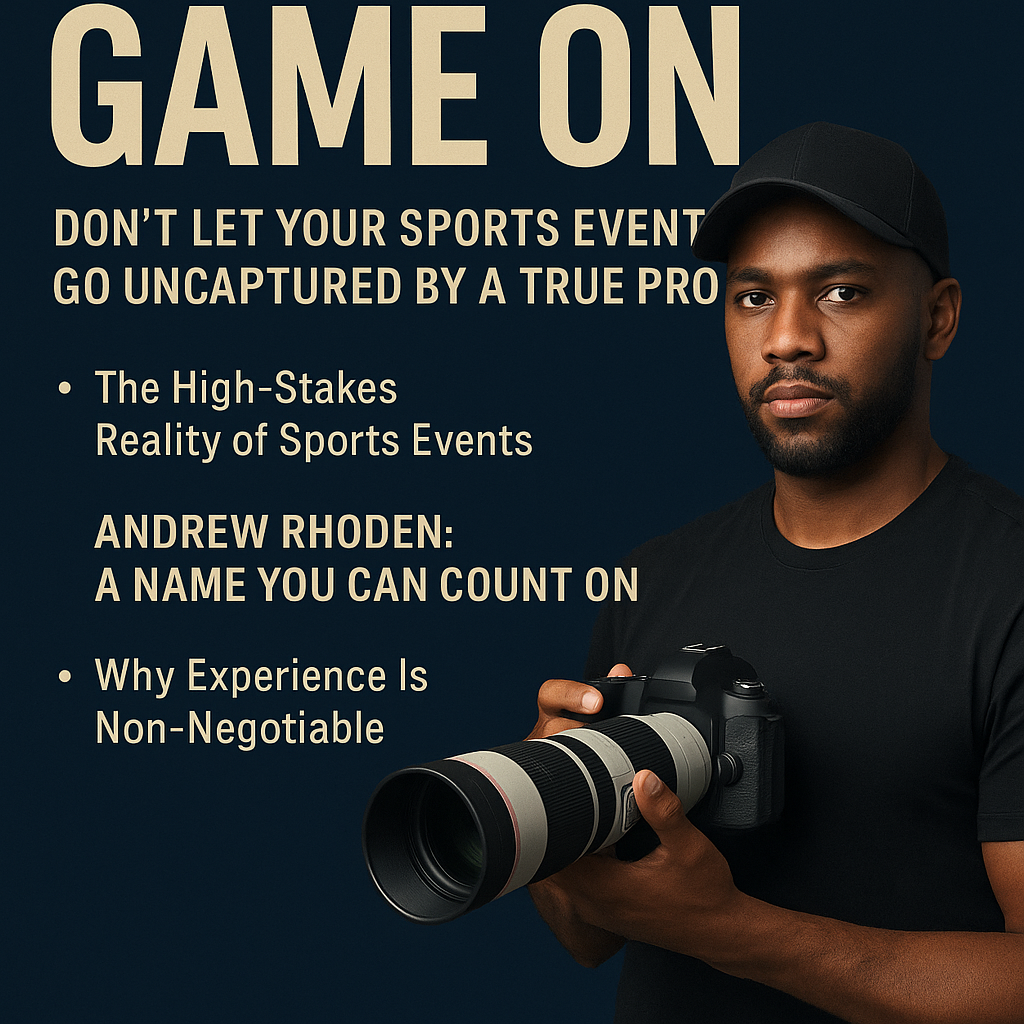

Game On: Don’t Let Your Sports Event Go Uncaptured by a True Pro
July 25, 2025
When the whistle
blows, the action doesn’t wait—and neither should your camera. Sports are about fast-paced moments, raw emotion, and adrenaline that surges in milliseconds. Miss a single second, and it’s gone forever. That’s why hiring a true professional like Andrew Rhoden, a seasoned sports photographer, is critical. You don’t get a second chance to capture a game-winning goal, a record-breaking sprint, or an intimate look into an athlete’s moment of triumph.
This article dives into the high-stakes nature of sports photography and explains why your event demands more than just someone with a camera—it demands someone with a real passion, experience, and world-class photography skills.
You get one shot—make sure the professional photographer behind the lens understands how high the stakes are.
What sets Andrew apart?
Andrew doesn’t just take pictures—he creates great shots that reveal the emotion, tension, and triumph of the sport.
Andrew Rhoden uses top-tier equipment and brings mastery to capturing fast-paced action shots, whether it’s surf photography, arctic surfing, or a crucial moment in the basketball scene.
You deserve a professional photographer who brings the same level of intensity as the athletes themselves. Andrew Rhoden has covered events and athletes across the country, taking on projects big and small—but always delivering photos that speak louder than words.
These influential photographers set the pace. Andrew Rhoden continues the tradition by applying that same level of excellence to every job.
Andrew Rhoden’s approach to capturing intimate moments ensures that each photo isn’t just documentation—it’s legacy.
Andrew doesn’t just cover sports—he understands them. That’s the secret behind his iconic images and growing list of clients.
Whether you’re targeting sports illustrated, Time Magazine, or your brand’s Instagram, Andrew’s work grabs attention and boosts credibility. His images have helped athletes gain sponsorships, teams secure press coverage, and organizations elevate their public presence.
Andrew Rhoden checks every box—and brings his passion to every project.
These are your peers. Make sure you’re telling your story just as powerfully.
The High-Stakes Reality of Sports Events
Every sports moment is a fleeting opportunity. You’re not just capturing an image—you’re capturing a story, a feeling, a peak performance.- You don’t pause the NBA Finals for a retake.
- There’s no reshoot at the Super Bowl.
- The Ryder Cup doesn’t wait for your focus to lock.
You get one shot—make sure the professional photographer behind the lens understands how high the stakes are.
Andrew Rhoden: A Name You Can Count On
Andrew Rhoden isn’t just a visual storyteller —he’s a visual storyteller trusted by athletes, teams, and brands nationwide. His work spans countless sporting events, from local football matches to coverage of athletes training for fifa world cups. With a career spanning nine years, Andrew’s eye for detail and dedication to capturing intimate moments separates him from others in the industry.What sets Andrew apart?
- Stunning images that feel like you’re in the game.
- A history of covering individual athletes and full teams.
- Experience with high-pressure moments—from horse racing to mountain biking and professional climbing.
Why Experience Is Non-Negotiable
Unlike casual photographers or hobbyists, experienced professionals know how to anticipate action before it happens. Sports photography requires mastery of:- Timing : Knowing when to shoot—whether it’s during a slam dunk or synchronized swimming routine.
- Lighting : Adapting to indoor gyms, night stadiums, or shadowy mountains.
- Positioning : Finding unique angles that elevate a moment to an iconic image.
Andrew doesn’t just take pictures—he creates great shots that reveal the emotion, tension, and triumph of the sport.
Not All Cameras—Or Photographers—Are Equal
It’s not just about gear. While many may own a camera, only a versatile photographer knows how to use it under stress. Shooting the Olympic Games or water polo isn’t the same as snapping vacation photos. Professional sports photography means:- High-speed lenses for fast motion.
- Backup systems to avoid failure.
- Expertise in editing and delivery.
Andrew Rhoden uses top-tier equipment and brings mastery to capturing fast-paced action shots, whether it’s surf photography, arctic surfing, or a crucial moment in the basketball scene.
Female Trailblazers in Sports Photography
In a field once dominated by men, the rise of female sports photographers and female action sports photographers is reshaping the industry. They’re capturing intimate looks at athletes and bringing new depth to the storytelling process. Their presence—alongside industry legends—shows how sports photography is evolving. It’s not just about coverage. It’s about connection, access, and perspective.From Local Fields to International Spotlights
You don’t have to be sports illustrated or national geographic to demand excellence. Whether your event is:- A high school football game
- A regional mountain climbing competition
- A Red Bull extreme action shoot
You deserve a professional photographer who brings the same level of intensity as the athletes themselves. Andrew Rhoden has covered events and athletes across the country, taking on projects big and small—but always delivering photos that speak louder than words.
Legendary Names That Set the Bar
Greatness in sports photography is often measured by the work of famous sports photographers like:- Neil Leifer – Time Magazine, Super Bowl, Muhammad Ali’s most iconic images.
- Chris Burkard – Master of big waves and geometric shapes in surf photography.
- James Rushforth – Known for mountain climbing magazine spreads and adventure imagery.
- Dave Lehl – A standout among action sports shooters.
- Adam Kokot – A Polish photographer capturing human strength in vertical worlds.
These influential photographers set the pace. Andrew Rhoden continues the tradition by applying that same level of excellence to every job.
Creating Emotion Through the Lens
Anyone can take pictures, but few can deliver stunning images that evoke real emotion. The difference? Knowing how to find those moments:- A tearful embrace after a match.
- The raw energy of a player on the sidelines.
- The breathless pause before a game-winning serve.
Andrew Rhoden’s approach to capturing intimate moments ensures that each photo isn’t just documentation—it’s legacy.
The Power of Versatility
From fifa world cups to synchronized swimming to mountain biking, versatility defines great photographers. A chief photographer must:- Move between sports with agility.
- Understand each sport’s rhythm and rules.
- Adjust style to meet the unique needs of the client.
Andrew doesn’t just cover sports—he understands them. That’s the secret behind his iconic images and growing list of clients.
Social Media & Storytelling
In a world where a single image can go viral in seconds, you need top photographers who get both the photography and the platform.Whether you’re targeting sports illustrated, Time Magazine, or your brand’s Instagram, Andrew’s work grabs attention and boosts credibility. His images have helped athletes gain sponsorships, teams secure press coverage, and organizations elevate their public presence.
What Makes a Great Sports Photographer?
The best in the field share several traits:- Keen observation and anticipation
- Ability to shoot in unpredictable environments
- Technical mastery of gear and post-production
- Deep understanding of many sports
- Real connection with athletes and event organizers
Andrew Rhoden checks every box—and brings his passion to every project.
Inspiration from the Field
Still wondering who to follow in this space? Check out:- Sports photographers to follow like Andrew Rhoden who post consistent, world-class work.
- Female action sports photographers redefining edge-of-your-seat storytelling.
- French sports photographers and Polish photographers bringing international flavor to the scene.
- Rangers FC and Scottish Rugby Union teams hiring the best to showcase their players' intensity.
These are your peers. Make sure you’re telling your story just as powerfully.
Every Event Deserves to Be Remembered
Sports fade, but photos remain. Don’t let your event become a memory lost to time. Invest in sports photography that honors the effort, talent, and story behind every whistle, pass, and goal.Why the Best Sports Photographers Stand Out from Countless Competitors
In a world filled with countless photographers, only a few rise to the top as the best sports photographers—those who consistently deliver jaw-dropping results in high-pressure environments. From capturing the spirit of the World Series to photographing all five FIFA World Cups, the most famous sports photographers built their reputations by being present for the moments that define sports history. Being named an official photographer at global events is a testament to precision, preparation, and unmatched instinct. Many of these legends started at a young age, honing their skills through relentless practice and unshakable passion. If you’re looking to find inspiration, study the careers of these industry giants—and hire a pro who follows in their footsteps with every frame.
Make the Call Before the Clock Runs Out
Whether you’re organizing a cham pionship game, a school tournament, or a corporate team event, now is the time to bring in a sports photographer who understands that every frame matters.Contact Masterly Studios today for a free consultation to learn how we can help you preserve the energy, emotion, and history of your sports event through high-impact imagery. We work with clients throughout the country and nationally—no event is too big or too small when it comes to capturing your legacy.
Call 469-902-9919 to book your free consultation now. Let's make sure your next sporting event is remembered for decades to come—with the right photographs taken by the right professional.
Recent Posts

By Angelie Te
•
August 15, 2026
Editorial Photography: How Story-Driven Images Support Brands, Publications, and Campaigns If your brand publishes articles, runs awareness campaigns, or maintains a magazine or blog, you already know that generic visuals fall flat. Readers scroll past them. Editorial photography offers something different: images built around a story, designed to make people stop, read, and remember. This guide breaks down what editorial photography is, how it differs from commercial work, where brands and publications use it, and how to plan a shoot that delivers narrative-driven results across channels. What Is Editorial Photography (and Why It Matters for Your Brand Today) Editorial photography refers to images created to support a story, article, or concept in a publication-whether that publication is a print magazine, a newspaper, a brand blog, or any of the growing number of online publications producing long-form content. The focus is on storytelling rather than selling products. Unlike stock photography, which provides generic visuals, editorial work is purpose-built to illustrate a specific narrative. This is distinct from corporate headshots, product shots, or basic branding visuals. Those assets serve important roles, but editorial photographs add narrative depth-they turn abstract ideas like sustainability, innovation, or community into human-centered stories that readers connect with emotionally. Editorial photography is often more subjective and creative than photojournalism, which is a type of photography focused on documenting real-time events. While photojournalism reports facts, editorial images interpret themes, weaving narrative through deliberate visual choices. The business case is straightforward. In surveys, roughly 46% of senior marketing executives say photography is "critical" to their storytelling efforts, and research shows that articles using strong visual storytelling can increase time-on-page by 30–50% compared with text-only content. That translates to better PR pickup, stronger campaign memorability, and deeper audience engagement. In the sections ahead, you'll learn where editorial style images fit in modern marketing, how an editorial photographer works alongside brands and editors, and how to plan a story-driven shoot from brief to delivery.

By Angelie Te
•
August 14, 2026
Why Environmental Portraits Matter for Modern Brands A studio headshot isolates a person against a neutral backdrop. An environmental portrait does the opposite: it places the subject in a real location, whether that's an engineering lab, a restaurant kitchen, or a warehouse floor, and lets the surroundings carry part of the story. Environmental portraits show subjects in their natural surroundings, revealing context, identity, and profession in a single frame. The reader problem is simple. Generic studio portraits feel interchangeable. A SaaS founder standing in a white sweep looks identical to every other founder on every other About page. Swap the background for that founder's product war room, with roadmap sketches on the wall and a prototype on the desk, and the image communicates something specific: who this person is, what they build, and how they think. Environmental portrait photography builds trust on About pages, pitch decks, LinkedIn profiles, and recruiting campaigns by showing real people in real workplaces. Key aspects of environmental portraits include context, narrative, authenticity, and compositional balance. This article covers leadership portraits, workplace portraits, and team photography in actual work environments. Masterly Visuals specializes in this kind of on-location photography. If you want to skip ahead, you can request a commercial portrait consultation at any time.

By Amber Aniston
•
August 12, 2026
Discover what commercial photography is, its key types, and how businesses use it to boost sales, recruit talent, and build brand identity. Learn how to plan a commercial image library with Masterly Visuals for consistent, high-quality visuals across all marketing channels.

By Angelie Te
•
August 8, 2026
Video marketing is essential in today's fast-moving real estate market, and commercial properties demand more from it than a simple home tour. This guide covers what real estate videography looks like when the asset is an office tower, logistics warehouse, retail center, or 200-key hotel - and why the discipline requires a fundamentally different approach than filming a family home. Below, you will find a practical breakdown of planning, shooting, editing, and deploying commercial property video to reach tenants, investors, and brand users who make decisions based on movement, scale, and location.

By Angelie Te
•
August 6, 2026
Why Brand Architecture Matters for Multi-Brand Founders Picture a founder in 2026 running a holding company with four entities: a SaaS platform, a consulting services arm, a recently acquired logistics startup, and a small media brand. Each has its own name, its own website, and its own sales deck. Prospects regularly ask, "Are these the same company?" The sales team at the SaaS platform has started describing the consulting arm as a competitor. The logistics acquisition still carries its old branding, and nobody has decided whether it should. This is a brand architecture problem. Brand architecture is the strategic framework that organizes a company's portfolio of brands, products, and services and defines both visible and invisible relationships among parent, sub, and sibling brands. It determines which names show up where, which logos appear on which materials, and how customers, investors, and employees understand your ecosystem. For founders, holding-company leaders, and multi-brand operators, brand architecture matters because it shapes customer clarity, acquisition integration speed, marketing efficiency, hiring narratives, and exit optionality. Poor brand architecture can lead to customer confusion and poor performance across every entity in the portfolio. This article covers the core brand architecture models (branded house, house of brands, endorsed, hybrid), how to choose and evolve a structure, and how to protect brand equity as your portfolio grows. What Is Brand Architecture? (Fast, Founder-Friendly Definition) Understanding brand architecture starts with a simple idea: it organizes how all the brands in your portfolio relate to each other and show up in the market. Brand architecture defines relationships between parent and sub-brands, covering everything from naming conventions and logo systems to messaging tone and website structure. It connects directly to your broader brand strategy, your brand positioning for each entity, and your day-to-day brand management decisions. This is not a chart on a slide deck. It is a set of intentional decisions about where brands share equity and where they stay independent. A well-defined brand architecture brings clarity to customers, partners, and internal teams about what belongs together and what stands apart. The classic terms you will encounter are branded house, house of brands, endorsed brands, and hybrid brand architecture. Each represents a different way of structuring brand relationships within a portfolio. The main types of brand architecture are Branded House, House of Brands, and Endorsed Brands, with hybrid models blending elements of each.