Real Estate Videography: Showing Movement, Scale, and Location for Commercial Listings
Video marketing is essential in today's fast-moving real estate market, and commercial properties demand more from it than a simple home tour. This guide covers what real estate videography looks like when the asset is an office tower, logistics warehouse, retail center, or 200-key hotel - and why the discipline requires a fundamentally different approach than filming a family home. Below, you will find a practical breakdown of planning, shooting, editing, and deploying commercial property video to reach tenants, investors, and brand users who make decisions based on movement, scale, and location.
What is real estate videography for commercial property?
Real estate videography captures professional video walkthroughs and aerial drone footage of properties to communicate spatial information that photos and floor plans cannot. For commercial real estate - office, industrial, retail, hospitality, and large multifamily - the scope goes well beyond aesthetics. Real estate videography transforms listings into immersive visual stories that reveal how a building actually works.
Property walkthroughs showcase homes room by room in residential contexts. Commercial property video does something different: it shows circulation patterns, operational infrastructure, and the relationship between a building and its surrounding area. A basic listing video might pan across a lobby and cut to a few interior shots.
A fully planned commercial property video layers interiors, exterior shots, drone footage, data overlays, and location context into a structured narrative.
Photo vs. video for commercial assets:
- Photos freeze a single moment; video shows directional flow - how people enter, move through corridors, and exit
- Floor plans display layout but not volume; video reveals ceiling height, depth, and light quality in motion
- Still images cannot communicate vehicle circulation, loading sequences, or pedestrian traffic
Residential vs. commercial needs:
- Residential priorities: emotional connection, décor, lifestyle, targeting individual home buyers
- Commercial priorities: operational clarity (dock counts, bay sizes, parking ratios), adjacency to infrastructure, multi-stakeholder audiences (investors, tenant reps, site selectors)
Why commercial listings need video in 2026
In 2026, serious tenants, investors, and brand-name retail users expect real estate videos in every major listing package. Properties marketed with video generate 3–4× more leads compared to photo-only listings, and video listings receive 403% more inquiries than photos alone.
Video content naturally captures attention longer than photos. Over 50% of home buyers find properties online through video, and the same behavior now defines commercial decision-makers. Asset managers, CMOs, and site selectors are time-poor - they use property videography to screen options remotely before committing to site tours. A well-produced video can create stronger emotional connections with potential buyers and tenants, and video content keeps potential buyers on websites longer, shortening the path from inquiry to tour.
Consider concrete examples. A 250,000 SF industrial park gains little from a photo gallery; a video showing clear height, dock-door count, and interstate access lets logistics tenants shortlist in minutes. A 200-key hotel video that highlights lobby circulation, amenities, and transit proximity attracts franchisee interest faster. Research from Greystar found that properties with professional video tours reduced vacancy by an average of five days, saving nearly $38,000 annually per property. Effective rents increased up to 20%. Video marketing leads to quicker bookings and stronger perceived value. Video helps buyers mentally visualize themselves living in the space - or, in commercial terms, operating a business there. High-production videography positions the agent as a premium marketer, and listings featuring video tours generate significantly more views and inquiries across every asset class.
What commercial real estate videography needs to show
Every commercial property video should tell a three-part story: how movement works inside and around the building, what scale is possible, and where the property sits relative to markets and infrastructure. Each element addresses a different decision-maker's concern - and each is a selling point that static media cannot deliver.
Movement (circulation):
- People flow: lobby traffic, corridor sequences, guest access in hospitality, customer ingress/egress in retail
- Vehicle circulation: parking access, truck docking, ingress/egress patterns, turning radii
- Connectivity between ground floor and upper levels, delivery routes, loading bays, elevators
Scale:
- Ceiling heights in warehouses and labs - display actual measurements via overlay
- Floorplate depth, column spacing, and the property's size relative to comparable assets
- Loading dock count, guestroom count, amenity square footage, parking capacity
- Neighborhood tours highlight local amenities and lifestyle around large campuses
Location context:
- Access to highways, transit stops, airports, and ports
- Nearby retail, dining, major employers, and educational institutions
- Zoning, signage visibility, walkability, and demographic character of the surrounding area
- Environmental factors: views, noise, topography, daylight orientation
Key formats of commercial real estate videos
Commercial marketing calls for different video formats, each serving a different purpose depending on asset type and platform.
- Cinematic listing video: 60–120 seconds, high production value with drone reveals, lighting, and narrative arc. Best for new developments, Class A office, luxury listings, and landmark retail. Platforms like Instagram and YouTube favor cinematic video content in this range.
- Walk-and-talk guided tour: 2–5 minutes, functional format showing layout, interior flow, and finishes. Ideal for remote decision-makers evaluating space before touring. Serves a different purpose than a teaser.
- Vertical social cutdowns: 15–45 seconds in 9:16 or 1:1 format. Teaser clips for social platforms - a drone reveal, an amenity highlight, a single feature. Shorter videos work well here for fast engagement.
- Drone and aerial footage: 10–30 seconds per segment showing lot size, access roads, aerial views of campus or surrounding context. Critical for industrial parks, resorts, and properties near transit hubs.
- Testimonial and case study videos: 45–120 seconds. Client testimonials build trust through personal experiences. Useful for investor relations, repositioning campaigns, and the luxury market. Before-and-after renovation videos showcase property transformations in redevelopment campaigns.
Teams create videos across these formats from a single shoot day to maximize coverage and budget. A development marketing video for pre-leasing pulls from the same footage as a social cutdown for lease-up.
Pre-production: planning a commercial property video
Pre-production is the biggest difference between casual real estate videos and professional production for commercial assets. The quality of your planning directly determines the quality of your final product.
- Creative brief: Define target audience (tenant rep, investor, franchise brand), use case (lease, sell, raise capital), and required deliverables (aspect ratios, lengths, graphic overlays). Identify the property type early so the shoot is structured around its specific needs.
- Shot list: A shot list saves hours of re-shooting and editing. For a logistics warehouse: approach road, aerial lot, truck docking sequence, interior showing ceiling height and racking. For a mixed-use destination: retail frontage, pedestrian movement, communal amenity, residential lobby, dining.
- Coordination: Lock access windows with property management and security. Schedule off-hours for exterior shots when parking is clear. Arrange tenant cooperation for interior views.
- Staging: Decluttering and cleaning are essential preparation steps for shooting real estate videos. Staged homes sell faster and for higher prices - the same principle applies to commercial lobbies, amenity spaces, and model suites.
- Technical planning: Assess lighting windows, weather, drone regulations, power sources, and camera gear. Confirm the project timeline with the production team.
On-site production: how we capture space, people, and place
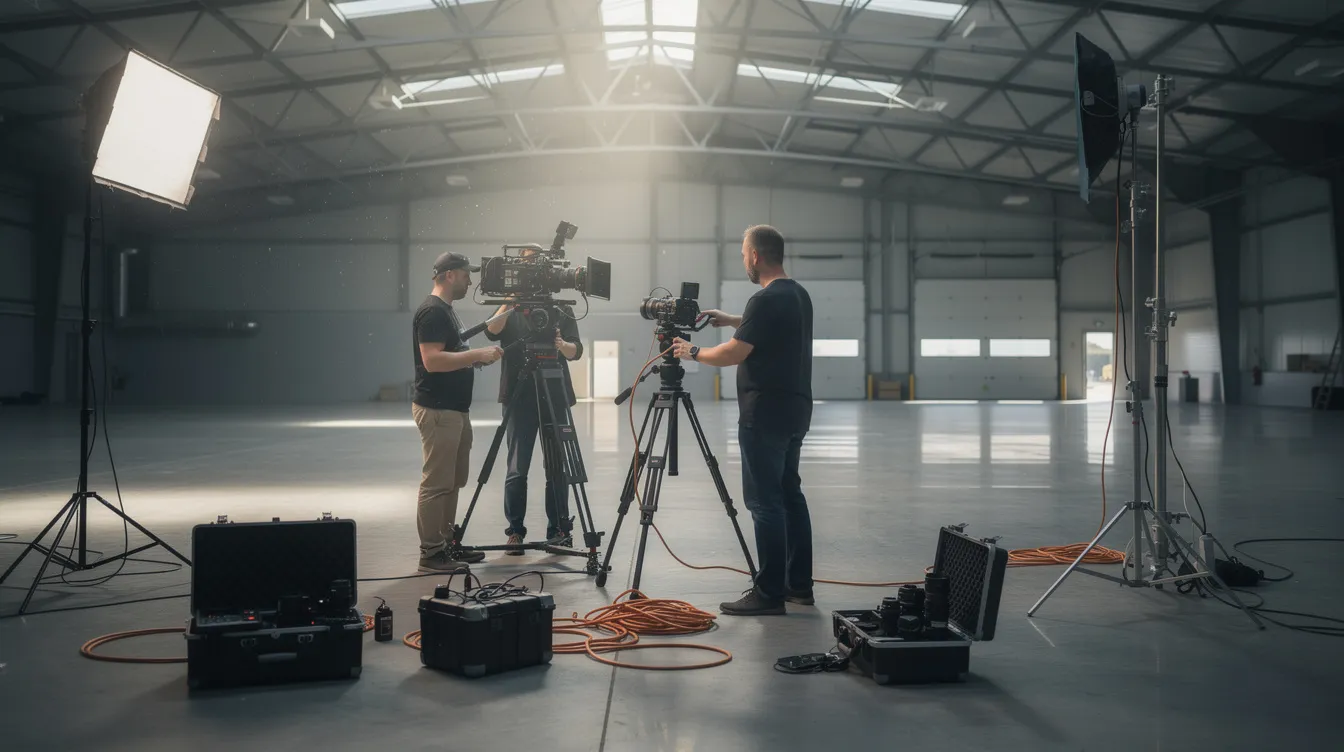
A typical shoot day starts early. Optimal shooting times for exteriors are during early morning or golden hour, when light is soft and shadows are controlled. The crew scouts approach roads, parking areas, and loading courts before moving indoors. Natural lighting is generally more attractive for real estate videography, though lighting is the biggest factor in video professionalism - so supplement where needed.
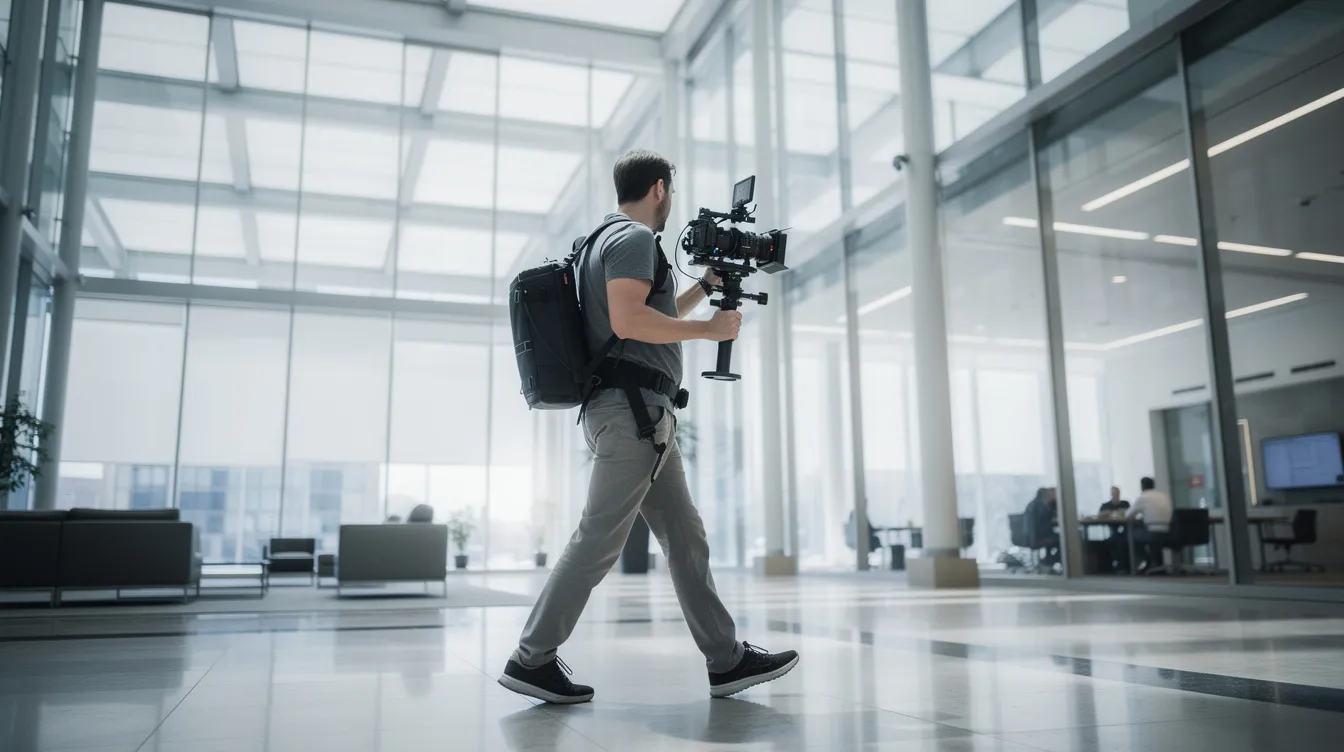
Mirrorless cameras are standard for real estate videography. A wide-angle lens of 16–24mm captures full rooms effectively, though using a wide angle lens too aggressively can distort space and undermine trust. Use both wide shots and close-ups in property videos to show volume and materiality. A 3-axis gimbal stabilizes camera shake during walkthroughs, and sliders handle controlled tripod moves for boardrooms and detail shots. Bi-color LED panels help match indoor lighting with natural light in spaces with mixed sources. Having the right gear matters, but planning the camera path matters more.
People appear sparingly - coworkers in a lounge, guests in a hotel lobby, staff near loading bays. The goal is to suggest activity and clean lines of movement without distracting from architectural details. We film sequences that follow logical circulation: building approach, entrance, lobby, cores, amenities, then back to exterior context. The video should create accurate expectations of the property being shown, not a stylized fantasy.
Using drone footage and exterior coverage to show location
Aerial drone footage is where commercial real estate videography earns its highest return. Shooting exteriors with drone footage can highlight surrounding amenities and neighborhood context in ways no ground-level camera can match.
Key drone shots for commercial assets:
- Establishing wide shot: Property in full context - skyline, highways, neighboring land uses, aerial views of the full site
- Approach shot: Following the main arterial road toward the building entrance
- Orbital rotation: Circling the building to reveal architecture, lot boundaries, and parking
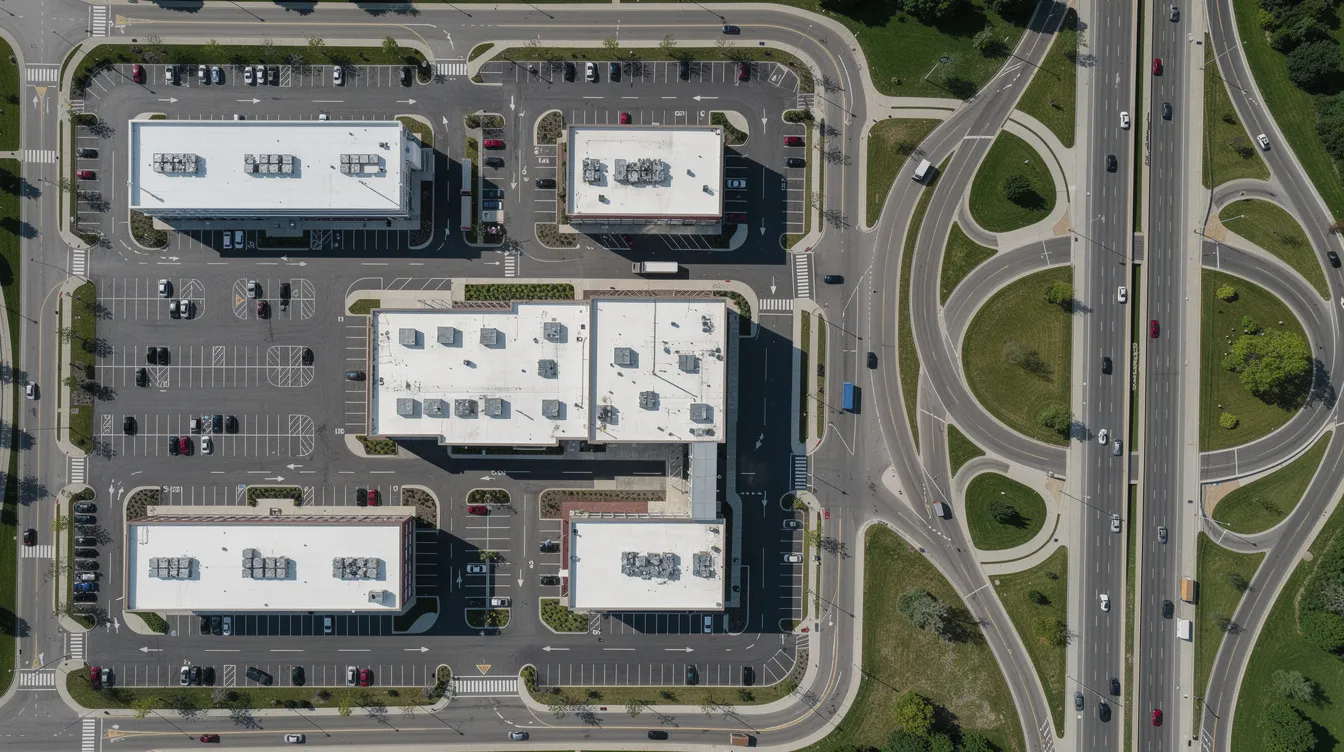
- Top-down (nadir): Lot layout, campus footprint, parking count from directly above
- Pull-back reveal: Starting tight on the building and pulling out to show proximity to interstate, transit, or city center
The DJI Mini 4 Pro drone shoots 4K footage for real estate and handles most commercial property shoots. For larger projects, DJI Air series drones or heavier platforms offer additional flight time and lens options. All commercial drone operations require FAA Part 107 certification - operators must be faa certified before any flight. Drone footage is most critical for large industrial parks, retail centers, resorts, corporate campuses, and properties near transit hubs.
Post production: turning footage into a clear story
Post production is where raw footage becomes a structured, on-brand marketing tool. The process follows a clear sequence: assemble, refine, brand, and export.
- Assemble: Organize footage by location and sequence. Cut the timeline to match the logical flow - location context first, then approach, exteriors, interiors, circulation, amenities, and closing context. Videos should be between 60 and 120 seconds long for listing use. Investor-focused cuts may run 2–3 minutes.
- Refine: Use simple transitions like clean cuts or short crossfades. Keep final edits between 60 and 120 seconds for listings. Edit to match the emotional tone of the property being shown - a Class A office feels different from an industrial campus.
- Brand: Include lower-thirds with property details and agent information. Add motion graphics for suite sizes, traffic counts, availability dates, and square footage overlays. Market updates provide insights on local real estate trends that can be layered into investor-facing versions.
- Audio: Use royalty-free music to avoid copyright issues. Select music that supports the asset's character. Layer in clean audio - ambient sound, footsteps, doors - for depth. Optional voice-over or broker narration guides viewers through the space.
The final video should create accurate spatial expectations. Color grading should be honest, and the final product should maintain consistent exposure between interiors and exteriors.
How video fits into a full commercial listing package
Real estate videography is one element in a coordinated property media kit alongside real estate photography, floor plans, stacking plans, and offering memorandums. Real estate platforms favor video content for enhanced search visibility, making video a core asset rather than an add-on.
- Embed video on listing pages across LoopNet, CoStar, Crexi, and the property website
- Include video links in OM PDFs and email campaigns to investors
- Loop video in on-site marketing centers and during broker tours
- Deploy vertical and square cuts across social platforms for lease-up campaigns
- Use during recapitalization pitches, pre-leasing new developments, and live Q&A sessions that engage potential buyers in real time
Multiple aspect ratios - 16:9 for listing pages, 1:1 and 9:16 for social - let marketing teams deploy quickly. Virtual tours and interactive media complement video but do not replace the narrative clarity a structured real estate video provides.
Working with a professional commercial real estate video production partner
When selecting a company for ongoing real estate video production, commercial brokers and property managers should evaluate beyond portfolio aesthetics.
- Commercial experience: Look for teams with work across industrial, retail, office, and hospitality. Many agents and real estate agents work with residential videographers who lack experience capturing loading docks, mechanical infrastructure, or campus-scale properties.
- Safety and insurance: Confirm proof of liability insurance, drone licensing, and safety protocols for crew and site access.
- Multi-market coverage: A partner operating across multiple locations delivers consistent quality and adapts to local airspace regulations and weather. Real estate videography can enhance an agent's brand perception and personal brand when the visual style is consistent across a portfolio.
- Questions to ask: What is the turnaround time from shoot to delivery? How many final edits and formats are included? What crew size and gear does the team bring? How do they handle access, scheduling, and staging?
One team handling both photography and videography streamlines scheduling, reduces costs, and keeps the visual brand consistent across every listing.
Frequently asked questions about commercial real estate videography
What does real estate videography cover for commercial properties? It covers motion media - interiors, exteriors, circulation, scale, location context, data overlays, and sometimes sustainability or mixed-use features. Estate videography for commercial assets differs from filming a luxury homes walkthrough or a family home tour.
What are typical project timelines? Pre-production runs 1–2 weeks (brief, shot list, permissions). The shoot takes one or more days depending on the site. Post production and revisions take another 1–2 weeks. Full delivery is typically 2–4 weeks for complex assets.
How many properties can be filmed in one day? For mid-size assets like a retail strip or small office, 2–3 in a day. For a large industrial campus or mixed-use destination, usually one property or a major subsection.
What is the difference between a walk-through and a cinematic listing video? A walk-through is functional - layout, rooms, finishes. A cinematic listing video includes narrative arc, drone shots, pacing, staging, and transitions. Property walkthrough videos cost between $300 and $1,500, while drone footage add-ons range from $150 to $500. Neighborhood videos typically cost between $500 and $2,000, and agent introduction videos range from $500 to $1,500. DIY videography can save costs for agents on a budget, but commercial assets typically require professional production.
When is drone footage recommended? Whenever lot size, location, skyline, approach roads, or views are material to decision-makers. Aerial footage is less useful in dense urban sites with airspace restrictions.
How do videos help out-of-market tenants or investors? They provide spatial understanding (ceiling height, layout flow), operational features (docks, access), and location context (transit, amenities). This reduces wasted site visits and lets where agents start conversations with pre-qualified interest.
What are next steps? Share your property type, size, phase, and timeline to begin a property media inquiry.
Next steps: request a commercial property media consultation
If you have a commercial listing, development, or repositioning project ahead, the next step is a focused conversation about what the property needs to communicate and who needs to see it. Share basic details - property type, size, location, timeline, and whether you need video only or integrated photo and drone coverage.
The goal of the consultation is to align real estate video production with your leasing, sales, or development marketing objectives - not just to film something that looks polished. Every property has a story defined by movement, scale, and location. The right video tells it clearly and compresses the decision cycle for every stakeholder who watches.
Request a commercial property media consultation to get started.
Recent Posts