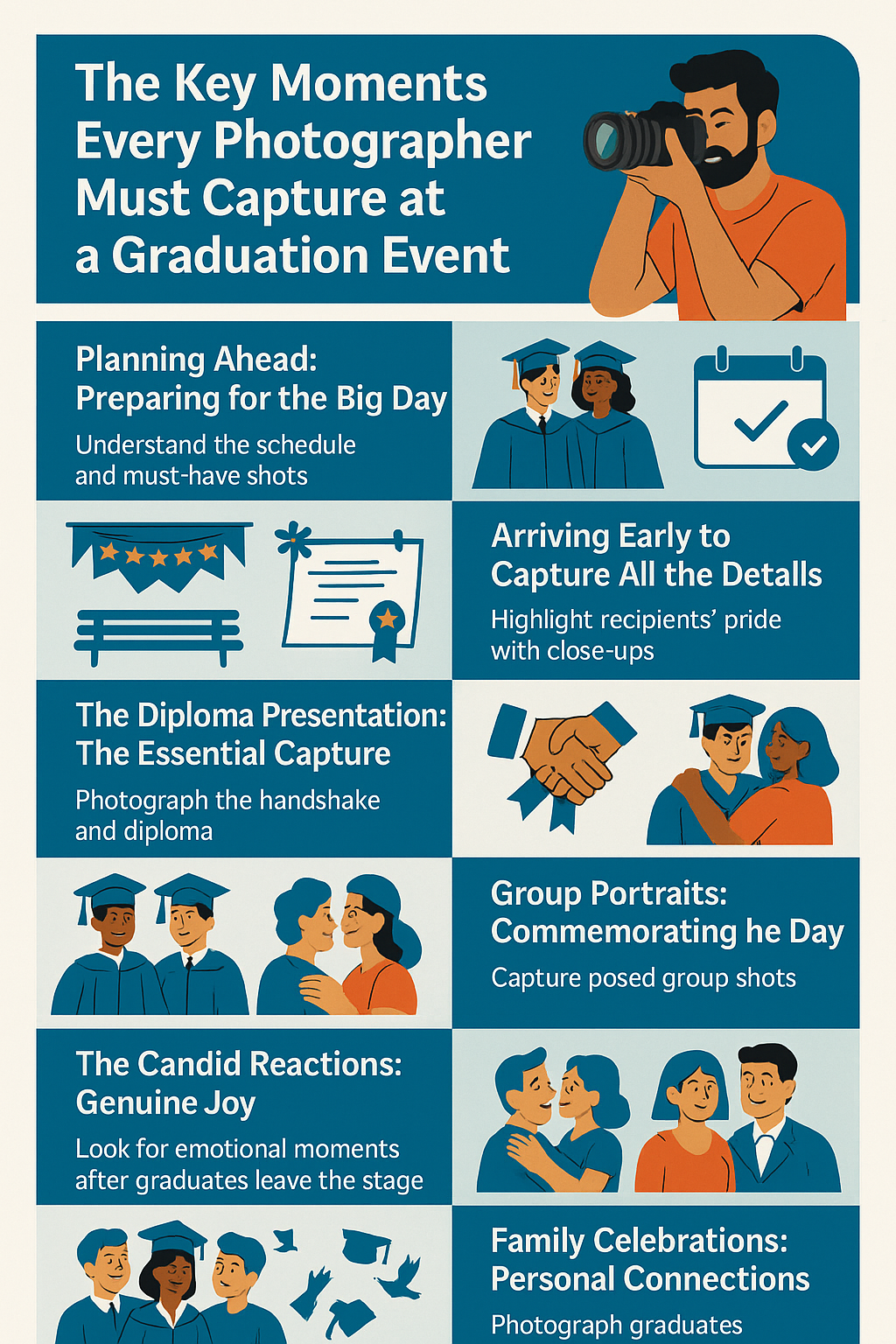

The Key Moments Every Photographer Must Capture at a Graduation Event

July 10, 2025

Share this article

Graduation is one of l ife’s most celebrated milestones. For families and graduates alike, it’s a day filled with memorable moments that deserve to be preserved forever. As a professional event photographer, your role is to document each detail with care and skill so everyone can relive the day through stunning photos.
In this guide, we’ll walk you through the key moments you should always look for when photographing a graduation. Whether you’re new to event photography or a seasoned professional expanding your photography services, these insights will help you plan, prepare, and deliver images your clients will treasure for years to come.


Planning Ahead: Preparing for the Big Day

Before you start shooting, it’s critical to understand the schedule and expectations of the event organizer. Take time to discuss the timeline, important traditions, and any must-have shots.
Creating a thorough shot list ensures you and your client are on the same page. This list helps you track each key moment, from the opening speeches to the final diploma presentation.


Arriving Early to Capture All the Details

Arriving a head of time gives you a chance to scout the venue, check the lighting, and choose the best angles. Use this window to photograph all the details—decorations, banners, and any signage that sets the scene.
These images might seem small, but they help tell the complete story when you deliver the final images.


The Venue and Atmosphere: Setting the Scene

Wide shots of the venue filled with event attendees create context and establish a sense of place. Capture the excitement as guests find their seats, greet each other, and get ready for the ceremony to begin.
Remember to adjust your camera body settings to handle different lighting scenarios. An on camera flash can help balance shadows in large spaces or under stage lighting.


The Processional: Capturing Anticipation

The processional is the moment wh en graduates enter the venue, often accompanied by proud smiles and applause. This is a great time to capture candid shots of anticipation and joy.
Position yourself to photograph faces clearly as graduates walk past. Quick bursts with your camera ensure you don’t miss any expression.

Award Ceremonies: Recognizing Achievement

Graduation often inclu des award ceremonies recognizing academic excellence or community contributions. These are moments filled with pride that deserve special attention.
Use a longer lens to capture close-ups of recipients as they shake hands or accept certificates. This helps showcase emotion while keeping the background soft.


The Diploma Presentation: The Essential Capture

Of all the key moments, the diploma presentation is often the most important. This is when every graduate wants the perfect photo.
Stand in a spot with a clear line of sight to the stage, and be ready to capture the handshake, the diploma, and the smile. If possible, take multiple shots to ensure you get at least one good image free of blinks or distractions.


The Candid Reactions: Genuine Joy

As soon as gra duates leave the stage, their reactions are often spontaneous and full of emotion. These are some of the most authentic moments to photograph.
Look for hugs with family, high-fives between friends, and relief on graduates’ faces. Candid images often end up being clients’ favorites because they feel real.


Group Portraits: Commemorating the Day

After the ceremony, it’s time to create formal and informal group photos. From full-class portraits to smaller friend groups, these posed portraits are essential for every graduate.
Use a wide lens when capturing large groups, and guide everyone into position so faces are clearly visible. Encourage natural expressions and adjust your camera settings to keep images sharp.


Family Celebrations: Personal Connections

Families will want p hotos together, so be prepared to photograph parents, siblings, and grandparents. These family photos are often printed and displayed for years.
If you can, take a moment to ask about any special relationships or requests. Personal touches make your event photography services stand out.

Candid Guest Shots: The Bigger Picture

While graduates ar e the main focus, remember to document guests enjoying the day. These images create a fuller story of the event itself.
Capture attendees chatting, laughing, and taking their own pictures. These supporting shots add warmth to your gallery.


Capturing the Decor and Venue Details

Between port raits, continue to photograph décor elements that make the day unique. This could be floral arrangements, banners, or themed decorations.
These details help preserve memories and are often appreciated by event planners and event organizers who worked hard to make the celebration special.

The Recessional: The Joyful Exit

As graduates exit the ceremony, there’s often a burst of excitement and relief. This is a perfect time to capture images filled with energy.
Walk alongside or ahead of the group, using a fast shutter speed to freeze movement without losing clarity.


The Cap Toss: An Iconic Celebration

The cap tos s is one of the most iconic graduation images. Coordinate with the event organizer to know exactly when it will happen so you can prepare.
Use burst mode on your camera body to get multiple frames and ensure you freeze the caps mid-air. This moment alone can become the highlight of your event photos.


Reception and Afterparty: Continuing the Story

Many graduatio ns end with a reception. This is another opportunity to document candid interactions and showcase your event photography skills.
Whether it’s a formal dinner or a casual gathering, these photos highlight the celebration that continues long after the diplomas are awarded.

Delivering Professional Final Images

After th e event, your work isn’t over. Carefully batch edit your images to ensure color consistency, crop distractions, and enhance clarity.
Deliver digital files in an organized gallery so clients can easily share and print their favorites. A professional presentation reinforces your reputation as a trusted event photographer.


Essential Equipment for Graduation Photography

Bring reliab le gear to handle the day’s challenges. Essentials include:
  • A primary camera body and backup
  • A versatile set of lenses (wide-angle and telephoto)
  • Extra memory cards and batteries
  • An on camera flash for indoor portraits

Having the right tools ensures you’re ready for any situation.


Different Types of Events Require Unique Approaches

While graduations have their own rhythm, other types of event like corporate events, wedding photography, birthday parties, and music festivals demand different techniques.
The key is to understand each clien t’s vision and adapt your approach to match their needs.

The Value of Experienced Photographers

Graduation days only happen once, and there are no second chances to get the photos right. An experienced photographer knows how to anticipate key moments, work under pressure, and deliver consistent results.
Your expertise builds trust and helps clients relax, knowing their memories are in good hands.


Working With Event Planners for a Smooth Experience

Collaboration w ith event planners ensures you know exactly what to expect. Clear communication helps you stay organized and capture every important detail.
When everyone works together, the experience is smoother for the graduates and their families.


Creating Images That Tell a Complete Story

The best gradua tion galleries feel like a narrative, showcasing every part of the day from start to finish.
When you photograph with intention, you create a collection of images that transport clients back to that moment every time they look at them.


Capturing Life as It Happens

In the end, graduati on photography is about preserving life’s big milestones. Each photograph is a reminder of effort, growth, and accomplishment.
When you focus on authentici t y and emotion, you deliver more than pictures—you deliver memories that last.


Professional Techniques for Capturing Unforgettable Graduation Moments

Whether you’re ex perienced in corporate event photography, trade shows, or red carpet galas, many of the same principles apply when shooting an event like a graduation. The best event photographers understand how to blend candid photos of attendees interacting with polished posed photos and classic posed group shots that families treasure.
Using the right event photography equipment—including fast lenses for low light, settings that balance ambient light and natural light, and a plan for each location—ensures you never miss those unforgettable moments. One of the most important event photography tips is to dress appropriately so you remain professional and blend in seamlessly during the ceremony. For most events, having a general idea of the schedule and the key features of the day helps every professional photographer deliver consistent, beautiful results. Whether you’re capturing a graduation or a corporate photography assignment, preparation and experience are what make each moment shine.

Essential Tips Every Event Photographer Should Know to Deliver Stunning Graduation Images

Even if you’re more familiar with corporate event photography, the fundamentals of capturing graduations remain the same. As an event photographer, you need to arrive prepared with reliable event photography equipment, from fast lenses to backup batteries. The best event photographers take time to plan their camera settings in advance so they can capture unforgettable moments without fumbling during key parts of the ceremony.
One of the simplest but most effective event photography tips is to dress appropriately, helping you blend in and remain professional among graduates and guests. After the celebration, carefully batch edit your event photos and deliver polished digital files that clients can treas ure. By combining preparation, skill, and attention to detail, you elevate every gallery into a showcase of excellence.

Using Professional Event Photography to Capture Unforgettable Graduation Moments

Graduations are full of milestones that only happen once, which is why professional event photography is essential to preserve every detail. Whether you’re shooting events in large auditoriums or intimate venues, preparation and skill make all the difference.
The right approach helps you capture unforgettable moments, from the proud walk across the stage to the emotional hugs that follow. By anticipating reactions and moving confidently through the crowd, you create a complete visual story that families will cherish. Professional photographers know that with careful planning and a focus on authenticity, every gallery becomes a lasting record of achievement and joy.

Partner With Us to Capture Your Graduation Memories

Your graduation dese rves more than snapsh ots—it deserves the care of a professional who understands how to capture each important moment with precision and artistry. At our studio , we work hard to create images you’ll treasure for a lifetime. Whether you’re planning a small gathering or a large ceremony, our experienced team is ready to help.
Contact us at 469-902-9919 to book a free consultation. We work with clients throughout the country and nationally to deliver exceptional event photography that tells your unique story.

Recent Posts

By Angelie Te August 15, 2026
Editorial Photography: How Story-Driven Images Support Brands, Publications, and Campaigns If your brand publishes articles, runs awareness campaigns, or maintains a magazine or blog, you already know that generic visuals fall flat. Readers scroll past them. Editorial photography offers something different: images built around a story, designed to make people stop, read, and remember. This guide breaks down what editorial photography is, how it differs from commercial work, where brands and publications use it, and how to plan a shoot that delivers narrative-driven results across channels. What Is Editorial Photography (and Why It Matters for Your Brand Today) Editorial photography refers to images created to support a story, article, or concept in a publication-whether that publication is a print magazine, a newspaper, a brand blog, or any of the growing number of online publications producing long-form content. The focus is on storytelling rather than selling products. Unlike stock photography, which provides generic visuals, editorial work is purpose-built to illustrate a specific narrative. This is distinct from corporate headshots, product shots, or basic branding visuals. Those assets serve important roles, but editorial photographs add narrative depth-they turn abstract ideas like sustainability, innovation, or community into human-centered stories that readers connect with emotionally. Editorial photography is often more subjective and creative than photojournalism, which is a type of photography focused on documenting real-time events. While photojournalism reports facts, editorial images interpret themes, weaving narrative through deliberate visual choices. The business case is straightforward. In surveys, roughly 46% of senior marketing executives say photography is "critical" to their storytelling efforts, and research shows that articles using strong visual storytelling can increase time-on-page by 30–50% compared with text-only content. That translates to better PR pickup, stronger campaign memorability, and deeper audience engagement. In the sections ahead, you'll learn where editorial style images fit in modern marketing, how an editorial photographer works alongside brands and editors, and how to plan a story-driven shoot from brief to delivery.
By Angelie Te August 14, 2026
Why Environmental Portraits Matter for Modern Brands  A studio headshot isolates a person against a neutral backdrop. An environmental portrait does the opposite: it places the subject in a real location, whether that's an engineering lab, a restaurant kitchen, or a warehouse floor, and lets the surroundings carry part of the story. Environmental portraits show subjects in their natural surroundings, revealing context, identity, and profession in a single frame. The reader problem is simple. Generic studio portraits feel interchangeable. A SaaS founder standing in a white sweep looks identical to every other founder on every other About page. Swap the background for that founder's product war room, with roadmap sketches on the wall and a prototype on the desk, and the image communicates something specific: who this person is, what they build, and how they think. Environmental portrait photography builds trust on About pages, pitch decks, LinkedIn profiles, and recruiting campaigns by showing real people in real workplaces. Key aspects of environmental portraits include context, narrative, authenticity, and compositional balance. This article covers leadership portraits, workplace portraits, and team photography in actual work environments. Masterly Visuals specializes in this kind of on-location photography. If you want to skip ahead, you can request a commercial portrait consultation at any time.
Commercial photography studio capturing professional brand imagery for business marketing.
By Amber Aniston August 12, 2026
Discover what commercial photography is, its key types, and how businesses use it to boost sales, recruit talent, and build brand identity. Learn how to plan a commercial image library with Masterly Visuals for consistent, high-quality visuals across all marketing channels.
Virtual staging transforms an empty room with digital furniture for real estate marketing.
By Amber Aniston August 10, 2026
Discover how virtual staging transforms real estate marketing by digitally furnishing empty spaces to attract buyers, reduce time on market, and enhance listing visuals with fast, cost-effective, and customizable solutions from Masterly Property Visuals.
Product photographer creating professional commercial product images
August 10, 2026
Hire a product photographer for ecommerce, catalog, commercial, and product launch photography with professional image licensing and product photography services.
Corporate photography services for business professionals
August 10, 2026
Corporate photography services for executives, employees, and businesses. Build a professional image library with strategic commercial photography planning.
By Angelie Te August 8, 2026
Video marketing is essential in today's fast-moving real estate market, and commercial properties demand more from it than a simple home tour. This guide covers what real estate videography looks like when the asset is an office tower, logistics warehouse, retail center, or 200-key hotel - and why the discipline requires a fundamentally different approach than filming a family home. Below, you will find a practical breakdown of planning, shooting, editing, and deploying commercial property video to reach tenants, investors, and brand users who make decisions based on movement, scale, and location.
Brand photographer creating executive and business brand photos for a professional company
August 7, 2026
Need a brand photographer for your business? Masterly Visuals creates professional image libraries for founders, executives, firms, websites, sales, and marketing.
Professional product photography services for brands
August 7, 2026
Need consistent product photography services? Masterly Visuals creates professional ecommerce, catalog, white-background, and lifestyle images for leading brands.
By Angelie Te August 6, 2026
Why Brand Architecture Matters for Multi-Brand Founders Picture a founder in 2026 running a holding company with four entities: a SaaS platform, a consulting services arm, a recently acquired logistics startup, and a small media brand. Each has its own name, its own website, and its own sales deck. Prospects regularly ask, "Are these the same company?" The sales team at the SaaS platform has started describing the consulting arm as a competitor. The logistics acquisition still carries its old branding, and nobody has decided whether it should. This is a brand architecture problem. Brand architecture is the strategic framework that organizes a company's portfolio of brands, products, and services and defines both visible and invisible relationships among parent, sub, and sibling brands. It determines which names show up where, which logos appear on which materials, and how customers, investors, and employees understand your ecosystem. For founders, holding-company leaders, and multi-brand operators, brand architecture matters because it shapes customer clarity, acquisition integration speed, marketing efficiency, hiring narratives, and exit optionality. Poor brand architecture can lead to customer confusion and poor performance across every entity in the portfolio. This article covers the core brand architecture models (branded house, house of brands, endorsed, hybrid), how to choose and evolve a structure, and how to protect brand equity as your portfolio grows. What Is Brand Architecture? (Fast, Founder-Friendly Definition) Understanding brand architecture starts with a simple idea: it organizes how all the brands in your portfolio relate to each other and show up in the market. Brand architecture defines relationships between parent and sub-brands, covering everything from naming conventions and logo systems to messaging tone and website structure. It connects directly to your broader brand strategy, your brand positioning for each entity, and your day-to-day brand management decisions. This is not a chart on a slide deck. It is a set of intentional decisions about where brands share equity and where they stay independent. A well-defined brand architecture brings clarity to customers, partners, and internal teams about what belongs together and what stands apart. The classic terms you will encounter are branded house, house of brands, endorsed brands, and hybrid brand architecture. Each represents a different way of structuring brand relationships within a portfolio. The main types of brand architecture are Branded House, House of Brands, and Endorsed Brands, with hybrid models blending elements of each.
Show More