Factories, production floors, warehouses, equipment, and industrial facilities can be difficult to present in a way that feels polished and meaningful. A quick snapshot may show what a facility looks like, but it may not communicate the quality of the operation, the people behind the work, or the technology supporting production.
That is where professional
industrial photography can make a difference.
Manufacturers and industrial companies need images for websites, annual reports, recruiting campaigns, sales materials, investor communications, social media, proposals, and marketing campaigns. The challenge is getting photographs that show the operation accurately while also presenting the company as organized, capable, safe, and professional.
Hiring an experienced industrial photographer gives your business a way to document its facilities, people, equipment, and processes with a consistent visual standard.
Why Industrial Photography Matters for Manufacturing Brands
Industrial companies often have complex operations that are difficult to explain with words alone.
A single production facility may include specialized machinery, skilled employees, quality-control processes, warehouses, offices, loading areas, and multiple stages of production across different types of operations and industries.
Strong images can help potential customers, employees, partners, and internal audiences understand that operation quickly while also proving the quality, scale, and capability behind it.
Professional
manufacturing photography can show more than a finished product. Manufacturers and industrial companies need images for websites, sales materials, recruiting, investor communication, and internal communication goals. It can communicate the scale of the facility, the precision of production, the people involved, and the systems that support the business.
These images can become valuable long-term brand assets.
Manufacturing Photography for Factories and Facilities
A factory is a major part of an industrial company's identity.
Professional photography can document the exterior of a facility, production areas, workstations, machinery, storage areas, office spaces, laboratories, warehouses, structural elements, and other important spaces.
The goal is to create a complete visual picture of the operation.
Professional manufacturing photography can show more than a finished product. It may also overlap with architectural and technical photography when documenting facilities and systems.
For a website, these images can help visitors understand what the company does. For sales materials, they can give prospects a better sense of the company's capabilities. For corporate communications, they can provide authentic visuals that represent the organization.
A consistent photography collection can also help avoid relying on generic stock images that do not represent your actual operation.
Show the Equipment Behind Your Production
Industrial equipment is often central to manufacturing.
Large machinery, automated systems, production lines, tools, robotics, control panels, specialized equipment, industrial structures, and office areas can demonstrate the technical capabilities of a company.
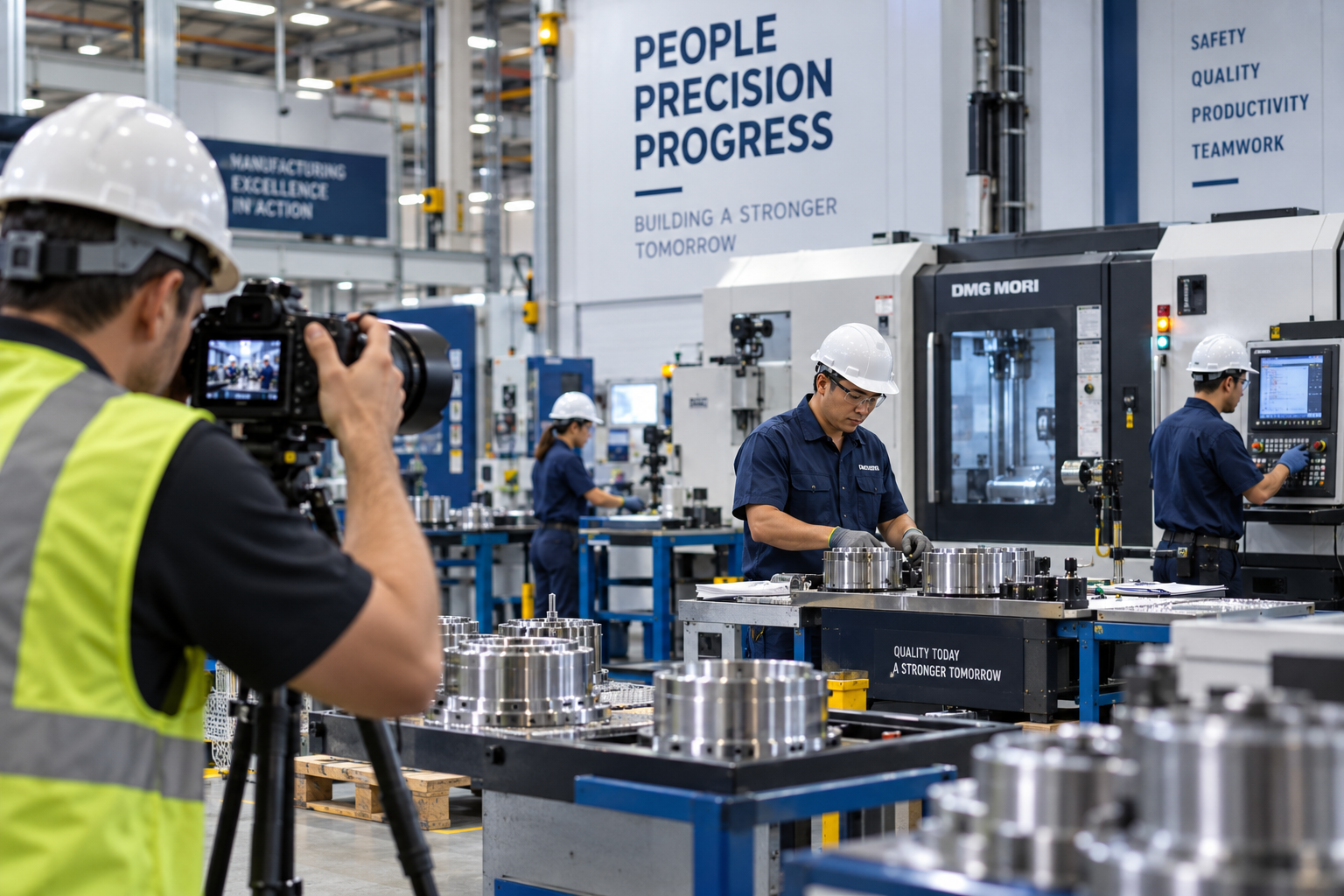
An experienced industrial photographer can photograph this equipment as part of the larger production story, documenting machinery in a way that helps capture the people, processes, and innovations behind the work rather than treating each machine as an isolated object.
The resulting images can support technical marketing, website content, brochures, presentations, sales proposals, and corporate communications.
They can also help prospective customers see the scale and sophistication of your operation before they ever visit the facility, and how your capabilities stand apart from the competition.
Manufacturing Photography That Shows People at Work
Machines are important, but people remain a major part of the manufacturing story, especially when the work involves documenting machinery in operation rather than treating it as an isolated object.
Employees operating equipment, inspecting products, managing production, performing quality control, working in laboratories often closed to the general public, and coordinating operations can show the expertise behind the company while capturing images of innovations in equipment and production capability.
Professional employee photography can help a manufacturing brand feel more human by showing each person as part of the wider process and the daily life of the facility.
It can also support recruiting efforts.
Potential employees want to know what a workplace actually looks like. Authentic images of employees performing real jobs can provide a more accurate picture of the work environment than generic workplace photography.
For companies competing for skilled workers, that visual story can also help a company stand out from the competition by showing real scale and sophistication.
Photographing Safety and Professional Standards
Safety is another important part of an industrial operation, and industrial photography should show the life of the operation through each person involved, not just the machines.
When appropriate, photography can show employees using required protective equipment, following established workplace procedures, and reflecting real safety protocols. Images can also document the professional environment in which production takes place, including parts of the operation the general public does not usually see.
This does not mean creating staged safety scenes that do not represent the actual workplace.
The strongest industrial images show the real operation in a controlled and professional way. Professional employee photography can help a manufacturing brand feel more human, and capturing authentic interactions between workers strengthens the authenticity of the final images.
Safety considerations also matter during the photography session itself. A professional photographer working in a manufacturing environment should understand that production areas may involve moving machinery, restricted areas, protective equipment, and other site requirements.
Document Manufacturing Processes
Manufacturing is a process, and photography can help tell that story.
Instead of photographing only the finished product, companies can focus on documenting key stages of production as clear visual documentation.
This may include raw materials, preparation, machining, assembly, inspection, packaging, storage, and shipment, along with employees following real safety protocols through protective equipment and workplace procedures.
A collection of process images can help customers understand how a product is made, how industrial processes work, and what happens behind the scenes.
For companies with complex production systems, this can make technical information easier to communicate. Photographers should also scout locations before shoots to understand the environment, access limits, and risks.
Photography for Annual Reports and Corporate Communications
Manufacturing companies often need professional images for corporate reporting and business communications, especially when they need to document industrial processes clearly for external and internal audiences.
Annual reports, company presentations, investor materials, leadership communications, sustainability reports, and corporate websites may all require photography that accurately represents the organization.
A professional photography library gives marketing and communications teams more flexibility.
Instead of searching for new images every time a project begins, the company can maintain a collection of current photographs showing its facilities, people, equipment, products, and operations, with image sets that document key production stages as visual records for customers and stakeholders. Wide-angle lenses are often useful for showing large industrial environments and the workflow context around them.
This can also create a more consistent visual identity across corporate materials, while giving teams practical examples to use across different formats. Post-processing also helps enhance clarity and detail in industrial photographs used for communication.
Industrial Photography for Marketing and Sales
Industrial businesses need strong visual content just like other companies.
Potential customers may visit your website before contacting your sales team. They may review your capabilities, facilities, equipment, team, and production process while deciding whether your company is a suitable supplier or partner.
Professional industrial photography can support that evaluation, with a clear focus on the operations, standards, and technical detail buyers want to see.
High-quality imagery helps present your business clearly and professionally. These photos can be used across marketing, sales, and corporate materials, including:
- Company websites
- Product and service pages
- Sales presentations
- Brochures
- Trade show displays
- Social media
- Email campaigns
- Case studies
- Proposals
- Advertising
- Press materials
- Corporate presentations
- Annual reports
- Investor materials
- Sustainability reports
One professional photography session can therefore produce a library of images that supports multiple business needs.
Build a Photography Library That Works Across Your Business
One of the biggest advantages of professional manufacturing photography is the ability to create a useful image library rather than a small collection of disconnected photographs.
A production day can potentially cover multiple visual needs, and potential customers may visit your website to evaluate the imagery and photos you use to present your capabilities.
For example, the same shoot may support multiple
projects and include facility-wide images, equipment photographs, employee portraits, production scenes, detail shots, process documentation, coverage of construction projects, and scenes from logistics operations designed for marketing campaigns.
This gives your marketing team more options.
It also helps create visual consistency across different channels while focusing on the capabilities and operational details buyers care about.
Why Hiring a Manufacturing Photographer Matters
Manufacturing environments are different from ordinary commercial spaces.
There may be limited access areas, large machinery, difficult lighting conditions, reflective surfaces, safety requirements, moving equipment, and complex production schedules.
A professional manufacturing photographer needs to work within that environment while producing images that meet the company's communication goals.
The photographer also needs to understand what the images will be used for.
A photograph intended for a website hero image may need a different composition from an image intended for a technical brochure, annual report, recruiting campaign, or social media post.
Planning the photography around those uses can make the final image library more valuable, because industrial photography is a specialized form of commercial photography and each intended use may call for a different visual approach.
A planned shoot day can potentially cover multiple visual needs across the same facility or project, and on-white photography for parts or finished components may also be a specialty when clean catalog-ready images are required.
For example, the same project may include production-floor images, employee portraits, detail shots of equipment, exterior facility views, and logistics operations, with each form shaped by a different purpose.
Some projects also include construction photography to document construction projects and active worksites.
How Masterly Visuals Supports Industrial Companies
At Masterly Visuals, we help businesses create professional photography that represents their operations clearly and accurately.
For manufacturers and industrial companies, that can include facilities, equipment, employees, production processes, workplace environments, and other important aspects of the business.
Our approach focuses on creating images that can serve practical business purposes, not simply filling a photo gallery.
Whether you need photographs for a website redesign, recruiting campaign, annual report, sales materials, corporate communications, or ongoing marketing, we can help define a photography scope around those needs.
The result is a professional image library that gives your team useful visual assets across multiple channels.